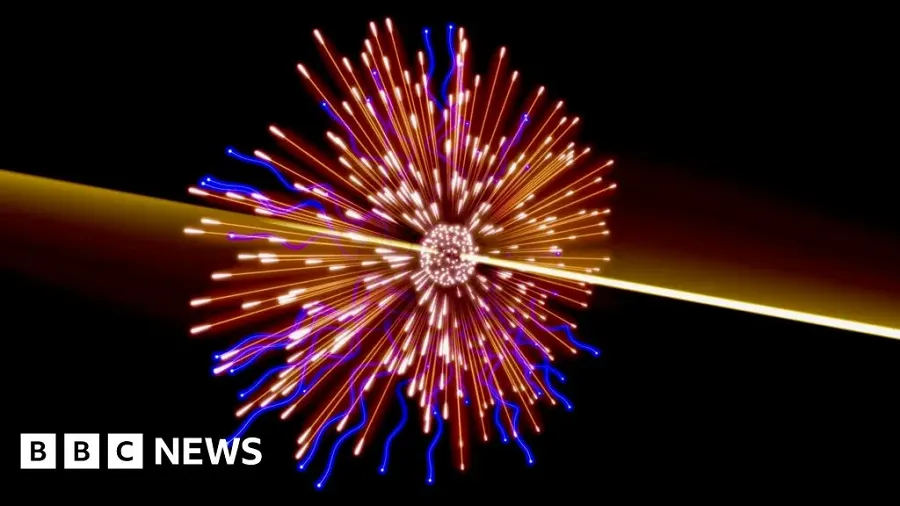
Scientists Detect Signals at Smallest Scale
Tap title to read story
Scientists have detected signals from the smallest distances ever probed, a scale a hundred billion times smaller than an atom.
The research, led by Cambridge scientists, came from an experiment at the Large Hadron Collider, a vast machine at CERN on the Swiss‑French border that smashes atoms together to reveal their inner structure.
The result could help researchers develop a new, more complete theory of how the Universe works.
Dark matter, which makes up a large part of the cosmos, remains invisible except for its gravitational influence.
In this experiment, particles were smashed together at high energy and scientists studied the shrapnel of collisions, including a beauty quark that decays in a billion‑trillionth of a metre.
More context
Timeline
- 2026-11-03 — Scientists Detect Signals at Smallest Scale
Why it matters
Immediate US impact: Investment boosts scientific research and technology development. Possible long-term US impact: Potential breakthroughs could drive future innovation and economic growth. Most affected groups: Scientists, research institutions, and technology firms. Reader priority: High interest for science and technology audiences.
Coverage notes
Center: Coverage from Yardbarker, CBS News, The Dallas Morning News frames this as a developing news story: Scientists Detect Signals at Smallest Scale. Reporting emphasizes verified facts, named sources, and near-term impact for readers. Left: Left-leaning desks covering the same development typically emphasize public impact, institutional accountability, and who is most affected. Right: Right-leaning desks covering the same development typically emphasize practical outcomes, market or security stakes, and institutional response.
Primary report
BBC — Scientists Detect Signals at Smallest Scale
Sources
JQJO Editorial Desk · Human reviewed · AI assisted. Report a correction.