Mathematician Stays Despite AI Breakthrough
Tap title to read story
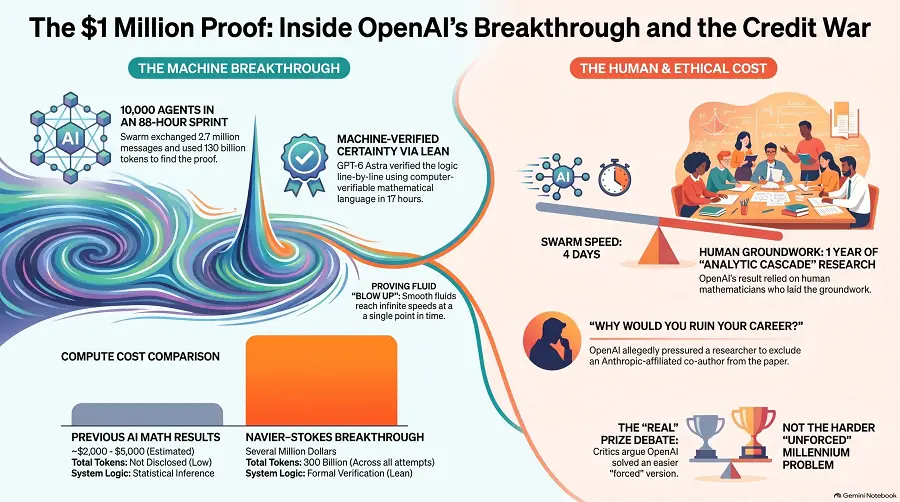
I nearly quit mathematics last year, but the field has delivered a landmark result: on 20 November, Levent Alpöge announced that, working with Claude, he had proved the Riemann hypothesis, a 167‑year‑old problem about the distribution of prime numbers.
The Lean and Mathlib communities have since certified the formal proof, and we are only beginning to understand the argument.
In May 2025 I led the number theory team for Epoch AI’s FrontierMath project, writing difficult problems to test large language models.
I watched an unreleased ChatGPT model compute all the moments of Tamagawa numbers of elliptic curves, drawing on work by Manjul Bhargava, Roger Heath‑Brown, and papers my father wrote in the 1960s.
More context
Timeline
- Sep 24, 2026 — We're gonna need a lot more mathematicians - Terence Tao
Why it matters
Immediate US impact: Mathematicians are adapting to AI's role in solving complex problems. Possible long-term US impact: AI's integration may reshape mathematical research and education. Most affected groups: Mathematicians and AI researchers are most affected by these developments. Reader priority: Understanding AI's impact on mathematics is crucial for future research.
Coverage notes
Center: Coverage from ia803200.us.archive.org, quora.com, reddit.com frames this as a developing news story: Mathematician Stays Despite AI Breakthrough. Reporting emphasizes verified facts, named sources, and near-term impact for readers. Left: Left-leaning desks covering the same development typically emphasize public impact, institutional accountability, and who is most affected. Right: Right-leaning desks covering the same development typically emphasize practical outcomes, market or security stakes, and institutional response.
Primary report
The Guardian US — Mathematician Stays Despite AI Breakthrough
Sources
JQJO Editorial Desk · Human reviewed · AI assisted. Report a correction.