Astronomers Witness Star's Death Spiral
Tap title to read story
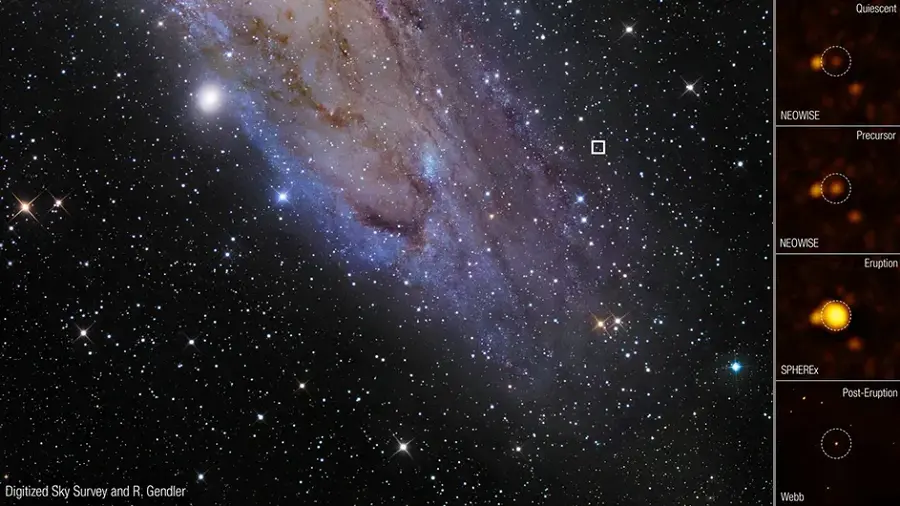
Astronomers observed a massive star in the Andromeda Galaxy slowly consuming its smaller companion over nearly a decade. This process, called common envelope evolution, was first proposed in the 1970s but never directly witnessed until now. A study published in Nature details how the star, seven times the mass of the Sun, engulfed its neighbor, causing it to spiral inward. The event lasted for years, a brief moment on cosmic timescales. The research, led by Viraj Karambelkar of Columbia University, provides new insights into how binary star systems evolve. The process involves shared gas envelopes and orbital friction, leading to tighter orbits or mergers. This discovery confirms long-standing theories about star system dynamics.
More context
Timeline
- On December 22 2022 Astronomers spot a planet caught in a disastrous death spiral.
- On December 8 2025 Pair of exploding stars baffle astronomers with new observations.
- On February 26 2026 Astronomers watch a star 1,540 times the size of our.
Coverage notes
Center: Coverage from The Brighter Side of News, msn.com, nypost.com frames this as a developing news story: Astronomers Witness Star's Death Spiral. Reporting emphasizes verified facts, named sources, and near-term impact for readers. Left: Left-leaning desks covering the same development typically emphasize public impact, institutional accountability, and who is most affected. Right: Right-leaning desks covering the same development typically emphasize practical outcomes, market or security stakes, and institutional response.
Primary report
Ars Technica — Astronomers Witness Star's Death Spiral
Sources
JQJO Editorial Desk · Human reviewed · AI assisted. Report a correction.