Audacious space heist aims to bring home bits of mysterious martian moon
PUBLISHED Oct 9, 2026, 7:07 AM ET
Read, Watch or Listen
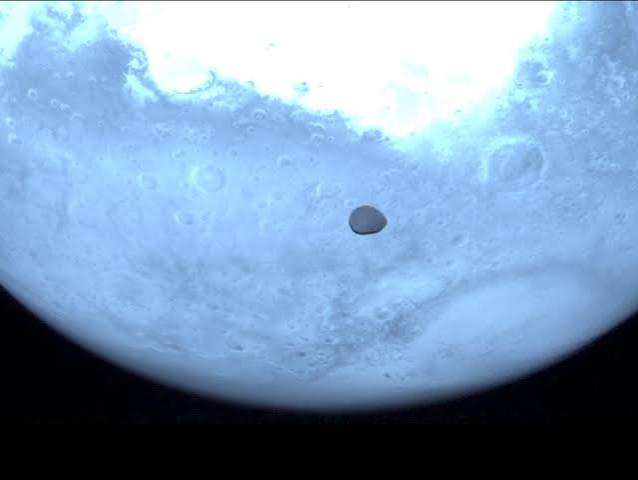
The Japan Aerospace Exploration Agency is advancing its ambitious Martian Moons Exploration mission to return surface samples from Phobos. Scheduled for future launch operations, the spacecraft intends to land on the larger Martian moon, gather regolith material, and transport physical specimens back to Earth for comprehensive scientific analysis. Researchers anticipate that examining pristine lunar material will finally resolve long-standing scientific debates regarding whether Phobos and Deimos originated as captured asteroids or massive impact debris generated by ancient collisions with Mars. The spacecraft is projected to complete its trajectory and release its sample-return capsule toward Earth around the next decade. International science teams continue preparing advanced laboratory facilities to analyze the extraterrestrial specimens safely upon arrival. The mission underscores expanding global efforts to explore planetary satellites and deepen humanity's understanding of the early solar system architecture through direct physical sampling techniques.
By Noormahi M. | JQJO News
Timeline of Events
- On Sept 15, 2024, JAXA announced revised mission schedules targeting future launch windows.
- On Jan 10, 2025, engineers completed primary spacecraft structural integration tests in Japan.
- On June 4, 2025, science teams finalized primary landing zones on the Phobos surface.
- On Nov 20, 2025, mission controllers executed successful deep-space communication link simulations.
- On Feb 12, 2026, researchers published new thermal inertia models for the Martian moon.
- On May 18, 2026, international laboratories established protocols for handling returned extraterrestrial regolith.
- On Oct 9, 2026, mission planners confirmed trajectory designs for upcoming interplanetary transfer maneuvers.
- On December 31 2026 In 2026, agencies will finalize final hardware qualifications for flight readiness reviews.
- On December 31 2027 In 2027, the spacecraft will launch toward the Martian system on an interplanetary trajectory.
- On December 31 2031 In 2031, the sample-return capsule will descend into the Australian desert.
News Intelligence
- Immediate US impact: NASA researchers collaborate on scientific data analysis and instrumentation planning.
- Possible long-term US impact: Advanced planetary science frameworks benefit from returned extraterrestrial material insights.
- Most affected groups: Space research institutions, planetary scientists, aerospace engineers, and astronomy educators.
- Reader priority: Monitor official space agency announcements regarding mission schedules and milestones.
Coverage of Story:
From Left
Chasing the origin of Mars's moons with a robotic sample retriever
The New York Times NBC News NPR The Atlantic Gizmodo Toronto Star The IndependentFrom Center
Japan targets Martian moon sample return mission for next decade
Reuters Associated Press NASA Spaceflight The Washington Post Politico USA Today New Scientist Science Magazine Bloomberg Financial Times Time Engadget Sky and Telescope Geophysical Research Letters Icarus The Hill Japan Times Asahi Shimbun Sydney Morning Herald CBC News Canada Evening Standard RTÉ NewsFrom Right
Aerospace agencies fund deep-space sample return missions
Wall Street Journal Forbes The Australian Daily Mail






Comments