How AI helped bring an ancient tomb dating to before the Roman empire back to life
PUBLISHED Oct 3, 2026, 6:30 AM ET
Read, Watch or Listen
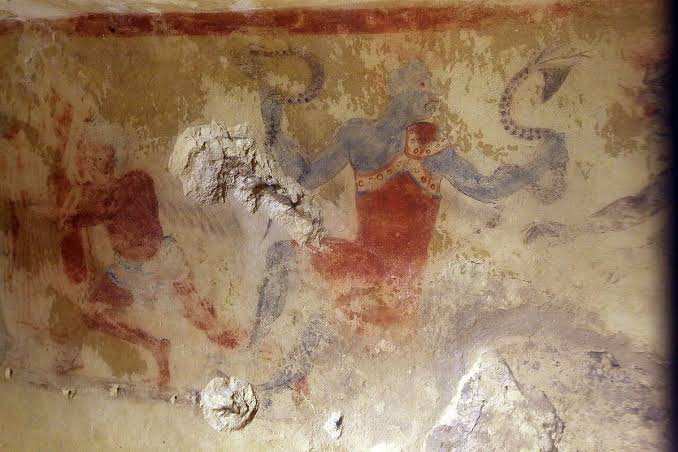
Researchers from Duke University and the University of Oxford utilized artificial intelligence, advanced 3D modeling, and acoustic mapping to reconstruct the sensory and psychological environment of ancient Etruscan tombs dating to the pre-Roman era. Led by scholars including Maurizio Forte and Jacqueline Ortoleva, the multidisciplinary team investigated how subterranean burial chambers were engineered to shape the movements, sightlines, and auditory experiences of living mourners during ancient funerary rites. Rather than functioning purely as static stone repositories, the findings indicate that different chambers produced contrasting psychological impacts, ranging from structured spatial progressions to highly disorienting environments marked by heavy echoes and restricted visibility. By synthesizing spatial, acoustic, and visual variables, the digital reconstruction offers historians a multi-disciplinary framework for understanding how pre-Roman civilizations orchestrated the spiritual transition of the deceased. The study demonstrates the growing role of machine learning in archaeological research for interpreting complex ritual spaces.
By Noormahi M. | JQJO News
Timeline of Events
- 01-01-0700 — On January 1, 700 BC, Ancient Etruscans constructed underground burial chambers in Italy.
- 01-01-2020 — On January 1, 2020, Researchers initiated preliminary digital documentation of ancient Etruscan tombs.
- 01-01-2023 — On January 1, 2023, Academic teams deployed acoustic and spatial mapping tools.
- 01-01-2024 — On January 1, 2024, Artificial intelligence models integrated visual and psychological simulation data.
- 01-01-2025 — On January 1, 2025, Researchers analyzed comparative psychological impacts between distinct tomb layouts.
- 01-15-2026 — On January 15, 2026, Duke University researchers compiled final data regarding ancient funerary acoustics.
- 02-10-2026 — On February 10, 2026, Study findings on multi-sensory archaeological reconstruction were finalized.
- 03-01-2026 — On March 1, 2026, Academic findings regarding Etruscan spatial engineering were published.
- 10-02-2026 — On October 2, 2026, Media outlets reported on technological applications in ancient archaeology.
- 10-03-2026 — On October 3, 2026, Researchers plan further digital reconstructions of pre-Roman archaeological sites.
News Intelligence
- Immediate US impact: US digital archaeology labs adopt artificial intelligence for spatial modeling.
- Possible long-term US impact: Universities expand multi-disciplinary technological training programs for historical preservation.
- Most affected groups: Academics, historians, technology researchers, and cultural heritage institutions.
- Reader priority: Prioritize peer-reviewed academic publications over generalized media coverage.
Coverage of Story:
From Left
Bringing pre-Roman tombs back to life with data
New York Times The Atlantic The IndependentFrom Center
AI reconstructs ancient Etruscan tombs sensory experience
Reuters Associated Press Smithsonian Magazine Archaeology Magazine NPR Chicago Tribune Miami Herald Dallas Morning News Houston Chronicle Seattle Times San Francisco Chronicle USA Today Bloomberg Time NBC News Politico The Hill Fast Company The Verge Newsweek Financial TimesFrom Right
Technology investments yield new insights into ancient history
Wall Street Journal Daily Mail Forbes





Comments