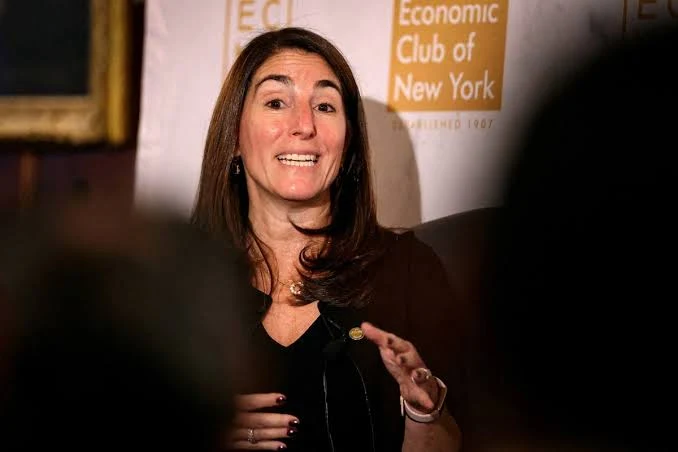
Fed's Hammack worried inflation expectations could deteriorate
Tap title to read story
Federal Reserve Bank of Cleveland President Beth Hammack stated on Friday that persistently high inflation risks conditioning the American public to accept elevated prices as the standard norm. Speaking at a bank event, Hammack emphasized that the central bank must maintain a restrictive monetary policy stance to drive inflation back down to its two percent target. She noted that consumer inflation has remained above target for over five years, fueled by robust economic performance and a stable job market rather than temporary external shocks alone. Although traditional inflation expectations appear stable, Hammack expressed concern that an entrenched inflationary mindset could develop among a generation unaccustomed to sustained target-level inflation. While stopping short of specifying immediate interest rate adjustments for upcoming meetings, her hawkish posture underscores ongoing central bank vigilance. The Federal Open Market Committee previously raised benchmark rates to a range between 3.75 and 4 percent to combat lingering price pressures.
More context
Timeline
- On July 15 2023 Personal consumption expenditures price index rose significantly.
- On August 15 2023 Federal Reserve officials reviewed ongoing consumer price trends.
- On September 10 2023 Cleveland Fed bank hosted regional economic policy discussions.
- On August 12 2025 Cleveland Fed President Beth Hammack delivered public remarks.
- On September 26 2025 Cleveland Fed President Beth Hammack warned about inflation.
- On September 28 2026 Financial markets anticipated upcoming Federal Reserve policy rate decisions.
- On September 29 2026 Economists analyzed ongoing consumer price index data trends.
- On September 30 2026 Business leaders evaluated borrowing costs across various sectors.
- On October 1 2026 Central bank officials monitored persistent domestic economic demand indicators.
- On October 2 2026 Policy analysts projected potential interest rate adjustments for late year.
Why it matters
Immediate US impact: Higher borrowing costs may persist across American financial markets. Possible long-term US impact: Persistent restrictive monetary policy could influence long-term price stability. Most affected groups: American businesses consumers investors and central bank policy makers. Reader priority: Monitor credible financial news outlets for official monetary announcements.
Coverage notes
Left: Highlighted economic inequality risks impacting vulnerable American working families. Center: Reported central bank official statements regarding persistent price trends objectively. Right: Emphasized robust economic growth drivers and business investment resilience.
Primary report
Cleveland Fed President Beth Hammack discussed inflation risks publicly on Friday.
Sources
- New York Times
- The Atlantic
- Reuters
- Bloomberg
- Wall Street Journal
- Financial Times
- Associated Press
- MarketWatch
- Washington Post
- Barron's
- Politico
- Forbes
- The Hill
- U.S. News & World Report
- USA Today
- Time
- National Public Radio
- ABC News
- Chicago Tribune
- San Francisco Chronicle
- Miami Herald
- Dallas Morning News
- Houston Chronicle
- Detroit Free Press
- Seattle Times
- Arizona Republic
- Star Tribune
- Cleveland.com
- Columbus Dispatch
- Pittsburgh Post-Gazette
- St. Louis Post-Dispatch
- Kansas City Star
- Sacramento Bee
- Orlando Sentinel
- Indianapolis Star
- Charlotte Observer
- Austin American-Statesman
- Baltimore Sun
- San Antonio Express-News
- Oklahoman
- Omaha World-Herald
- Des Moines Register
- Milwaukee Journal Sentinel
- Louisville Courier Journal
- Richmond Times-Dispatch
- Hartford Courant
- Providence Journal
- Las Vegas Review-Journal
- Albuquerque Journal
- Tulsa World
JQJO Editorial Desk · Human reviewed · AI assisted. Report a correction.