With new Macs, Apple aims to take on Microsoft, Nvidia in a rush to lower AI costs
Tap title to read story
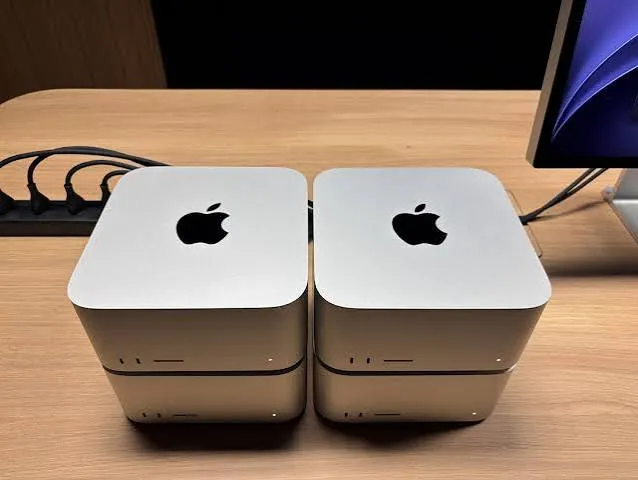
Apple announced a hardware strategy aimed at reducing artificial intelligence infrastructure costs by utilizing clustered Mac Studio computers to run large language models locally. During a recent product showcase, Apple demonstrated four Mac Studios operating collectively from a standard wall outlet to execute a trillion-parameter AI model for bug detection. Apple chief hardware officer Johny Srouji stated that hardware-based on-device processing eliminates the recurring subscription and token fees associated with cloud data centers. Competitors such as Microsoft are pursuing similar on-device capabilities through Windows architectures, though they face challenges supporting fragmented multi-vendor hardware ecosystems. Meanwhile, Nvidia continues to dominate high-end data center processing for AI training workloads. Apple intends to market its unified chip architecture as a scalable solution ranging from localized mobile devices to enterprise-grade desktop workstations, potentially shifting enterprise computation expenses away from cloud providers toward localized fixed hardware investments.
More context
Timeline
- On September 1 2026 Apple showcased four Mac Studios running trillion parameter models.
- On September 5 2026 industry analysts evaluated potential impacts on enterprise AI budgets.
- On September 10 2026 Microsoft outlined Windows strategies for unmetered on device intelligence.
- On September 12 2026 Jensen Huang discussed Nvidia strategies regarding personal computer hardware markets.
- On September 15 2026 Johny Srouji detailed architectural scaling principles across Apple product lineups.
- On September 18 2026 developers tested localized memory allocations for enterprise debugging environments.
- On September 20 2026 corporate purchasers reviewed total cost of ownership comparisons for data centers.
- On September 21 2026 hardware benchmarks confirmed power consumption metrics for stacked workstation clusters.
- On September 22 2026 market researchers published findings on local versus cloud processing economics.
- In coming months enterprise software vendors will release optimized local model runtimes.
- By late 2027 corporate adoption of local workstation clusters is expected to grow.
Why it matters
Immediate US impact: Corporate purchasers may reduce recurring cloud token costs significantly. Possible long-term US impact: Enterprise AI infrastructure spending could shift toward fixed local hardware. Most affected groups: Enterprise developers, hardware investors, and corporate IT executives are affected. Reader priority: Monitor verified hardware benchmarks and official developer documentation updates across outlets.
Coverage notes
Left: Emphasizes corporate cost reductions and potential shifts in computing power. Center: Focuses on hardware specifications, market competition, and architectural scaling comparisons. Right: Highlights free market competition and corporate efficiency in enterprise investments.
Primary report
Johny Srouji announced AI hardware cost strategies during media briefing on September 1 2026.
Sources
- San Francisco Chronicle
- New York Times
- The Atlantic
- Gizmodo
- Reuters
- Bloomberg
- The News International
- WSAU
- Cryptorank
- Coinpaper
- NDTV Profit
- Samaa TV
- Euronext
- Wall Street Journal
- Financial Times
- Engadget
- Forbes
- PCMag
- VentureBeat
- The Register
- Associated Press
- MarketWatch
- Barron's
- Axios
- Washington Post
- USA Today
- Chicago Tribune
- The Seattle Times
- The Hill
- Politico
- Time
- Newsweek
- Fast Company
- Inc.
- AnandTech
- AppleInsider
- ExtremeTech
- Hacker News Blog
- Venture Beat AI
JQJO Editorial Desk · Human reviewed · AI assisted. Report a correction.