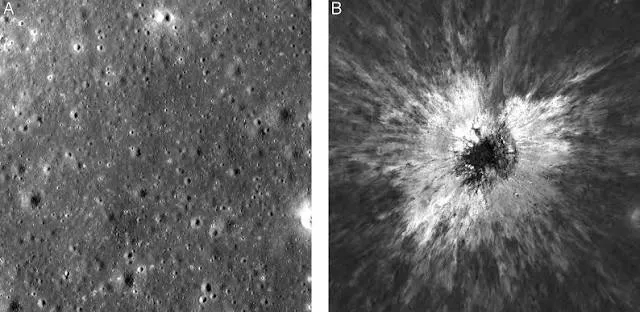
NASA spacecraft discovers a huge new crater on the moon
Tap title to read story
Scientists analyzing data from NASA's Lunar Reconnaissance Orbiter have discovered a massive impact crater on the Moon measuring approximately 225 meters in diameter and 43 meters deep. Officially named McGetchin, the steep-sided crater was formed by a high-speed asteroid or comet impact between April and May 2024. The event went undetected in real time but was uncovered during routine comparative image analysis. Researchers report that such large-scale impacts occur roughly once every century, serving as a rare natural laboratory to study lunar surface dynamics. The impact forcefully churned subsurface regolith across a wide area, creating a distinctive thermal cold spot and demonstrating that lunar soil turns over much faster than previously estimated. This rapid geological activity means historical surface features, such as Apollo astronaut footprints, will erode significantly faster. Understanding these frequent surface shifts provides critical safety data for engineers designing well-protected structures for upcoming crewed lunar bases.
More context
Timeline
- On Oct 24, 2025, scientists identified unusual surface changes in wide-angle images.
- On Dec 05, 2025, narrow-angle camera photos revealed detailed crater size and shape.
- On Feb 18, 2026, thermal instruments mapped a four-mile-wide cold spot around impact.
- On Mar 17, 2026, researchers presented initial findings at the lunar planetary conference.
- On Sep 16, 2026, formal studies were published in the journal Science Advances.
- On Sep 16, 2026, NASA officially announced the discovery of the McGetchin crater.
- On Sep 16, 2026, researchers confirmed impact occurred between April and May 2024.
- On Sep 16, 2026, scientists updated lunar regolith gardening and soil erosion timelines.
- In coming months, engineers will evaluate ejecta hazard risks for bases.
- In coming years, teams will refine lunar surface stability models.
Why it matters
Immediate US impact: NASA updates lunar mission safety and base design guidelines. Possible long-term US impact: Refined regolith models improve planning for sustained human habitation. Most affected groups: Aerospace engineers, lunar researchers, planetary scientists, and space agencies. Reader priority: Focus on official NASA announcements and peer-reviewed scientific studies.
Coverage notes
Left: Highlighted scientific innovation and implications for future lunar base safety. Center: Focused strictly on objective facts released by NASA research teams. Right: Emphasized technological achievements and American leadership in space exploration.
Primary report
NASA announced the discovery of the McGetchin lunar impact crater.
Sources
- New York Times
- Time
- The Atlantic
- San Francisco Chronicle
- Gizmodo
- Associated Press
- NASA Official Blog
- The Watchers
- USRA Newsroom
- PR Newswire
- Universe Space Tech
- WTOP News
- KTVB
- Washington Post
- Reuters
- NPR
- New Scientist
- Wall Street Journal
- USA Today
- NBC News
- Politico
- Bloomberg
- Miami Herald
- Chicago Tribune
- Houston Chronicle
- Seattle Times
- Dallas Morning News
- The Hill
- Axios
- GeekWire
- Engadget
JQJO Editorial Desk · Human reviewed · AI assisted. Report a correction.