Trump Administration Advances DC Ballroom, Underground Bunker, and Triumphal Arch Projects
Tap title to read story
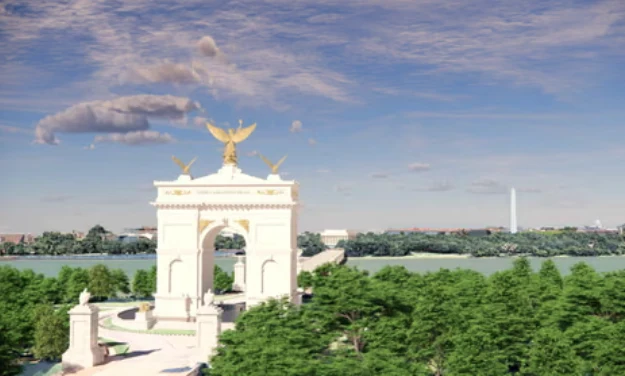
Construction activity continues across Washington on major federal development projects initiated by the Trump administration, encompassing a significantly expanded White House ballroom, an underground military complex, and a monumental triumphal arch. The developments follow the demolition of the historic East Wing of the White House. The associated ballroom project has expanded from an initial plan for a 650-seat structure costing two hundred million dollars to a one thousand-seat facility with a total cost of six hundred million dollars. Administration statements indicate the ballroom structure serves as an upper enclosure for a six-storey, military-grade underground bunker housing emergency operations centers and medical facilities. Legal challenges surrounding the construction reached the United States Supreme Court, which permitted work to resume without ruling on the underlying legality of the projects. Concurrently, design plans advanced for a large triumphal arch featuring a sixty-foot golden-winged statue atop a structure clad in white granite blocks.
More context
Timeline
- On July 31, 2025, the White House announced initial plans for a ballroom.
- On October 2025, the historic East Wing of the White House was demolished.
- On April 2, 2026, the National Capital Planning Commission approved the project designs.
- On May 21, 2026, the Commission of Fine Arts approved a revised arch design.
- On August 12, 2026, federal cost estimates for the projects reached six hundred million.
- On August 21, 2026, Chief Justice John Roberts issued a temporary construction stay.
- On September 1, 2026, the Supreme Court allowed construction work to resume.
- On September 3, 2026, interior officials announced initial excavation for the arch project.
- On September 14, 2026, architectural criticisms highlighted ongoing construction impacts in Washington.
- In coming months, federal work crews will continue expanding capital construction projects.
Why it matters
Immediate US impact: Federal construction projects alter the architectural landscape of Washington permanently. Possible long-term US impact: Expanded executive infrastructure spending sets significant national property precedents for future administrations. Most affected groups: Federal officials, preservationists, architects, and Washington residents are most directly affected. Reader Priorities: Readers should prioritize official court filings and architectural commission announcements across outlets.
Coverage notes
Left: Framing emphasizes architectural destruction, executive overreach, and vanity project concerns. Center: Framing reports legal battles, Supreme Court rulings, and project costs objectively. Right: Framing highlights national security upgrades, patriotic monuments, and necessary capital infrastructure.
Primary report
The Guardian published an architectural critique of Washington construction projects on Monday.
Sources
- The Guardian
- The Guardian
- The Independent
- CNN
- Washington Post
- New York Times
- Associated Press
- Associated Press
- Associated Press
- Associated Press
- Associated Press
- Associated Press
- Anadolu Agency
- Mail and Guardian
- Arab News
- Wikipedia
- Reuters
- Politico
- The Hill
- Bloomberg
- NPR
- USA Today
- BBC News
- Al Jazeera
- Time
- Axios
- Fox News
- Wall Street Journal
- National Review
JQJO Editorial Desk · Human reviewed · AI assisted. Report a correction.