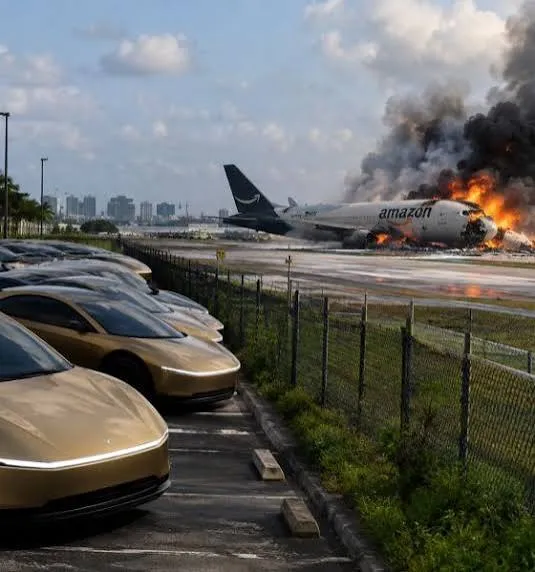
Cybercab Narrowly Avoids Boeing 767 Crash in Miami
Tap title to read story
On September 6, 2026, a Boeing 767-300 cargo aircraft operated by 21 Air for Amazon Prime Air overran the runway upon landing at Miami International Airport, resulting in at least five fatalities and five injuries. The aircraft crashed through a perimeter fence, coming to a halt in a storage lot that held over twenty newly arrived Tesla Cybercabs. These gold autonomous vehicles had been shipped to Florida following their recent service rollout in Austin. Initial reports from the scene confirmed that no Cybercabs sustained damage or destruction during the incident, and no injuries were linked to the vehicles. The event highlights the growing intersection of commercial aviation logistics and autonomous vehicle deployment infrastructure. Federal aviation authorities have launched an investigation into the runway overrun. Emergency responders managed the wreckage and treated the injured at the site. The proximity of the storage facility to the runway underscores urban safety concerns regarding vehicle fleet placement.
More context
Timeline
- On September 3 2026 Tesla integrated autonomous Cybercabs into Austin robotaxi services.
- On September 6, a cargo jet landed at Miami International Airport.
- On September 6, the cargo aircraft overran the airport runway completely.
- On September 6, the plane breached the perimeter fence into parking.
- On September 6, five fatalities resulted from the severe cargo plane crash.
- On September 6, five injuries were officially reported from the accident.
- On September 6, wreckage stopped directly adjacent to parked Tesla Cybercabs.
- On September 6, initial inspections confirmed zero damage to autonomous vehicle fleets.
- On September 7, federal investigators examined airport runway overrun causes thoroughly.
- On September 8, authorities reviewed airport perimeter safety standards and zoning rules.
Why it matters
Immediate US impact: Aviation safety reviews increase for airport perimeter vehicle storage lots. Possible long-term US impact: Stricter zoning rules govern autonomous vehicle storage near active runways. Most affected groups: Miami International Airport, Amazon Prime Air, Tesla logistics operators, regulators. Reader priority: Monitor official NTSB updates and verified local transport journalism reports.
Coverage notes
Left: Highlighted regulatory oversight and airport safety infrastructure vulnerability concerns. Center: Reported factual details regarding the runway overrun and casualties objectively. Right: Emphasized commercial logistics and autonomous fleet asset protection implications.
Primary report
Cargo jet overran Miami airport runway into vehicle lot on September 6 2026
Sources
- Futurism
- New York Times
- The Independent
- San Francisco Chronicle
- Reuters
- Miami Herald
- Times of India
- Wikipedia
- India Today
- Global News
- CBS News
- Hindustan Times
- Motor1
- NBC News
- Wall Street Journal
- Bloomberg
- Washington Post
- USA Today
- Politico
- Financial Times
- Forbes
- ABC News Australia
- CBC News Canada
- The Hill
- Axios
- Newsweek
- Chicago Tribune
- The Seattle Times
- Houston Chronicle
- Orlando Sentinel
- Forbes Technology
- The Street
- Daily Express US
- Sky News
- Daily Mail
JQJO Editorial Desk · Human reviewed · AI assisted. Report a correction.