NASA’s newest space telescope launches on a quest to explore the hidden universe
PUBLISHED Aug 30, 2026, 1:15 PM ET
Read, Watch or Listen
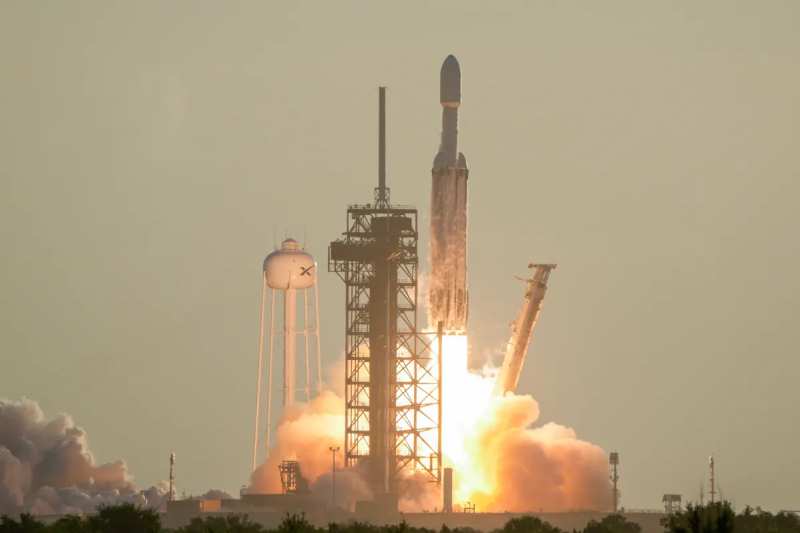
NASA successfully launched the Nancy Grace Roman Space Telescope Sunday from Kennedy Space Center in Florida, beginning a three-month journey toward the Sun-Earth L2 region about one million miles away. The $4.3 billion observatory lifted off at 7:26 a.m. EDT aboard a SpaceX Falcon Heavy and separated from its upper stage at 7:58 a.m., NASA reported. Roman will survey enormous areas of the sky in infrared wavelengths, studying dark energy, dark matter, galaxies, black holes and planets beyond our solar system. Its field of view is at least 100 times wider than Hubble’s, while NASA says its surveys can operate about 1,000 times faster. The mission has a five-year primary lifetime, with an additional five-year goal. NASA expects Roman’s first images in early 2027. The observatory will travel to L2, undergo deployments, calibration and testing, then begin scientific observations. Its data will complement Hubble, Webb, Euclid and Rubin Observatory surveys.
By James Porter | JQJO News
Timeline of Events
- 1959 — On 1959, NASA appointed Roman its first chief astronomer officially.
- 1990 — On 1990, Hubble launched, establishing NASA’s flagship optical space observatory.
- 2012 — On 2012, NRO donated two unused spy mirrors to NASA.
- 2020 — On 2020, NASA renamed WFIRST after Nancy Grace Roman officially.
- On Jan 29 2026, construction of Roman was completed successfully.
- On June 21 2026, Roman arrived at Kennedy for launch.
- On Aug 28 2026, launch readiness review cleared mission officially.
- 2026-08-30 07:26 EDT — On Aug 30 7:26 a.m., Roman launched aboard Falcon Heavy.
- 2026-08-30 07:58 EDT — On Aug 30 7:58 a.m., Roman separated from second stage.
- Early 2027 — By early 2027, NASA expects Roman’s first images publicly released.
- 2027 — During 2027, Roman should begin science after commissioning and calibration.
- 2031 — By 2031, NASA may evaluate extending Roman’s primary science mission.
News Intelligence
- Immediate US impact: NASA advances flagship astronomy and space-science capabilities.
- Possible long-term US impact: Roman may reshape cosmology, exoplanet research, observatory design.
- Reader priority: Readers should prioritize NASA data, primary statements, independent analysis.
- Most Affected: NASA, astronomers, universities, aerospace contractors, students, taxpayers nationwide.
- Articles Published:
- 17
- Right Leaning:
- 1
- Left Leaning:
- 3
- Neutral:
- 13
- Distribution:
- Left 18%, Center 76%, Right 6%
Left: Coverage may emphasize public investment, access, science funding, and oversight. Center: Coverage emphasizes launch facts, mission goals, timelines, costs, capabilities clearly. Right: Coverage may emphasize American leadership, technology, competition, and achievement strongly.
NASA confirmed launch success at 7:26 a.m. EDT August 30. https://www.nasa.gov/news-release/nasas-dark-universe-seeking-nancy-grace-roman-space-telescope-launches/
Coverage of Story:
From Left
NASA's newest space telescope launches on a quest to explore the hidden universe
The Washington Post The Guardian Houston ChronicleFrom Center
NASA launches powerful new Roman Space Telescope, a spy satellite turned to the stars
Reuters Associated Press CBS News The Wall Street Journal The Verge Scientific American Space.com The Planetary Society Spaceflight Now collectSPACE Forbes SpaceDaily Korea Times




Comments