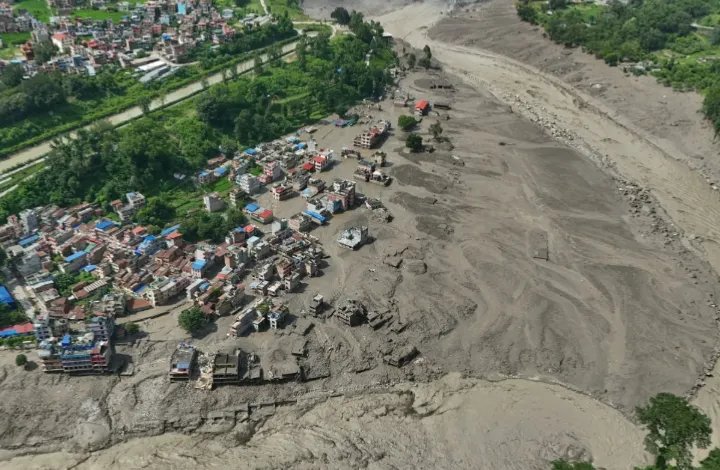
At least 160 killed and hundreds missing after flash floods in Nepal and China
Tap title to read story
At least 160 people have died and hundreds remain missing after a flash flood swept through Nepal’s Himalayan border region and Tibet on Wednesday, destroying homes, roads, bridges and power infrastructure. Nepalese police reported 157 deaths, while Chinese state media reported three deaths and 265 missing in Tibet’s Gyirong County. Nepal’s Tourism Board said 403 people were unaccounted for, including 341 foreign nationals and 47 Americans, although casualty and missing-person figures remain subject to change. The disaster struck around 9 a.m. local time along the Bhote Koshi River and affected Rasuwa, Nuwakot and other downstream districts. Preliminary assessments indicate an ice or snow-rock avalanche may have blocked a river before a sudden surge, while officials have also examined seismic activity as a possible trigger. Rescue operations are continuing, but damaged infrastructure and difficult terrain are hampering access. Nepal has requested assistance from India and China, while governments monitor missing citizens.
More context
Timeline
- On July 8, 2025, glacial flooding struck Bhotekoshi, killing residents.
- On August 26, 2026, flooding suddenly devastated Nepal's northern border.
- On August 26, 2026, Nepal reported 157 deaths from flooding.
- On August 26, 2026, China reported three deaths in Tibet.
- On August 26, 2026, 403 people were reported missing nationally.
- On August 26, 2026, 341 foreign nationals remained unaccounted for.
- On August 26, 2026, twenty-eight Nepalese police officials remained missing.
- On August 26, 2026, nineteen bridges and roads were destroyed.
- On August 27, 2026, rescue teams continued searching affected communities.
- On August 27, 2026, governments monitored missing foreign nationals closely.
- Within days, authorities will revise casualty totals as searches continue.
- Within days, rescue access should improve as floodwaters gradually recede.
- Within weeks, Nepal will assess infrastructure losses and reconstruction needs.
- Within months, scientists may clarify the flood's precise geological trigger.
- Within years, Himalayan authorities may strengthen glacier hazard monitoring systems.
Why it matters
Immediate US impact: Forty-seven reported missing Americans create immediate U.S. consular concerns abroad. Possible long-term US impact: Long-term risks may increase U.S. disaster-response and climate diplomacy demands. Reader priority: Readers should prioritize official casualty updates and verified rescue reports. Most Affected: Tourists, pilgrims, workers, police, and hydropower employees face greatest risks.
Coverage notes
Left: Coverage emphasizes climate vulnerability, humanitarian consequences, and risks facing vulnerable communities. Center: Coverage emphasizes confirmed casualties, missing people, rescue efforts, infrastructure damage, and uncertainty. Right: Evidence insufficient for a distinct right-leaning framing in direct coverage.
Primary report
On August 26, 2026, 9 a.m., Nepal Police warned riverside residents.
Sources
- Scroll
- Al Jazeera
- The Guardian
- The Washington Post
- Scientificamerican
- Thewire
- AP News
- Reuters
- Kathmandupost
- Radionepalonline
- Nepalnews
- Onlinekhabar
- Ratopati
- Khabarhub
- Fiscalnepal
- Nepalviews
- Nepalsamaj
- Indianexpress
- Indiatimes
- Hindustantimes
- Ndtv
- Indiatoday
- Business Standard
- Ianslive
- Outlookindia
- Thestatesman
- Ft
- Channelnewsasia
- Straitstimes
- Dawn
- m.thewire.in
JQJO Editorial Desk · Human reviewed · AI assisted. Report a correction.