30-Year Treasury Yields Hit Highest Level Since 2007 Amid Weak Data and Fiscal Woes
Read, Watch or Listen
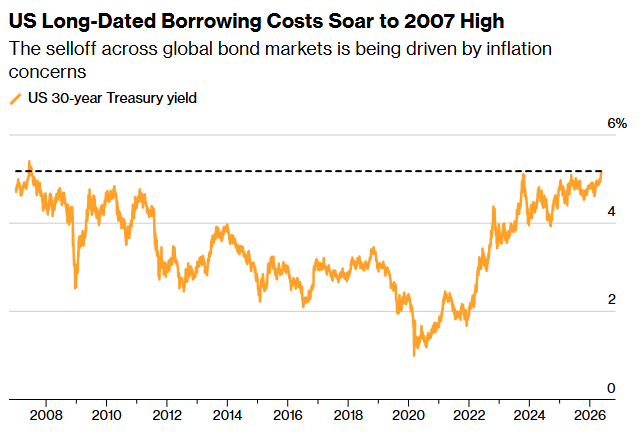
U.S. stocks fell Monday as the 30-year Treasury yield climbed to 5.3103%, its highest close since 2007, despite weaker economic data that normally could support lower yields. The 10-year yield rose to 4.724%. Retail sales unexpectedly declined 0.6% in July, while markets reduced the probability of a September Federal Reserve policy move. Reuters reported that Barclays strategist Anshul Pradhan pointed to fiscal concerns, heavy corporate bond issuance and weak demand at the long end of the Treasury market as factors behind the unusual bond selloff. A recent 30-year Treasury auction produced a yield near 5.22%, the highest for such an auction since 2001, before secondary-market yields moved higher. Oil prices also rose as tensions involving Iran raised supply concerns, adding inflation pressure. The S&P 500 fell 0.52%, the Dow 0.51% and Nasdaq 0.31%. The episode highlights competing pressures from slowing demand, government borrowing, corporate financing, oil prices and geopolitical risks.
Reviewed by editorial team.
Timeline of Events
- On June 12, 2007, 30-year Treasury yield reached 5.356% intraday.
- On March 9, 2020, 30-year Treasury yield fell below 1%.
- On August 13, 2026, Treasury sold 30-year bonds near 5.22%.
- On August 14, 2026, U.S. retail sales unexpectedly fell 0.6%.
- On August 17, 2026, 30-year Treasury yield closed near 5.31%.
- On August 17, 2026, U.S. stocks ended broadly lower Monday.
- On August 17, 2026, oil prices rose amid Iranian concerns.
- On August 18, 2026, markets assessed fiscal and inflation pressures.
- Over coming weeks, Treasury auctions may test demand for duration.
- Over coming months, persistent yields could raise refinancing costs nationwide.
News Intelligence
- Immediate US impact: Long-term borrowing costs remain elevated, pressuring mortgages, businesses, financing, valuations.
- Possible long-term US impact: Persistent high yields could raise federal interest costs, constraining growth.
- Reader priority: Readers should prioritize Treasury data, official releases, and independent reporting.
- Most Affected: Borrowers, homebuyers, businesses, investors, taxpayers, and rate-sensitive sectors face pressure.
- Articles Published:
- 12
- Right Leaning:
- 0
- Left Leaning:
- 1
- Neutral:
- 11
- Distribution:
- Left 8%, Center 92%, Right 0%
Left: Left framing emphasized fiscal strain, inequality, and household borrowing costs. Center: Center framing emphasized yields, data, auctions, and competing market forces. Right: Right framing emphasized debt, spending, inflation, and Treasury market discipline.
On August 17, 2026, Treasury data confirmed elevated long-term yields. https://home.treasury.gov/resource-center/data-chart-center/interest-rates/TextView?field_tdr_date_value=2026&type=daily_treasury_yield_curve
Coverage of Story:
From Center
30-Year Treasury Yields Hit Highest Level Since 2007 Amid Weak Data and Fiscal Woes
Reuters Reuters Barron's The Wall Street Journal MarketWatch The Associated Press Financial Times The Times Moneycontrol The Chosun Daily AxiosFrom Right
No right-leaning sources found for this story.






Comments