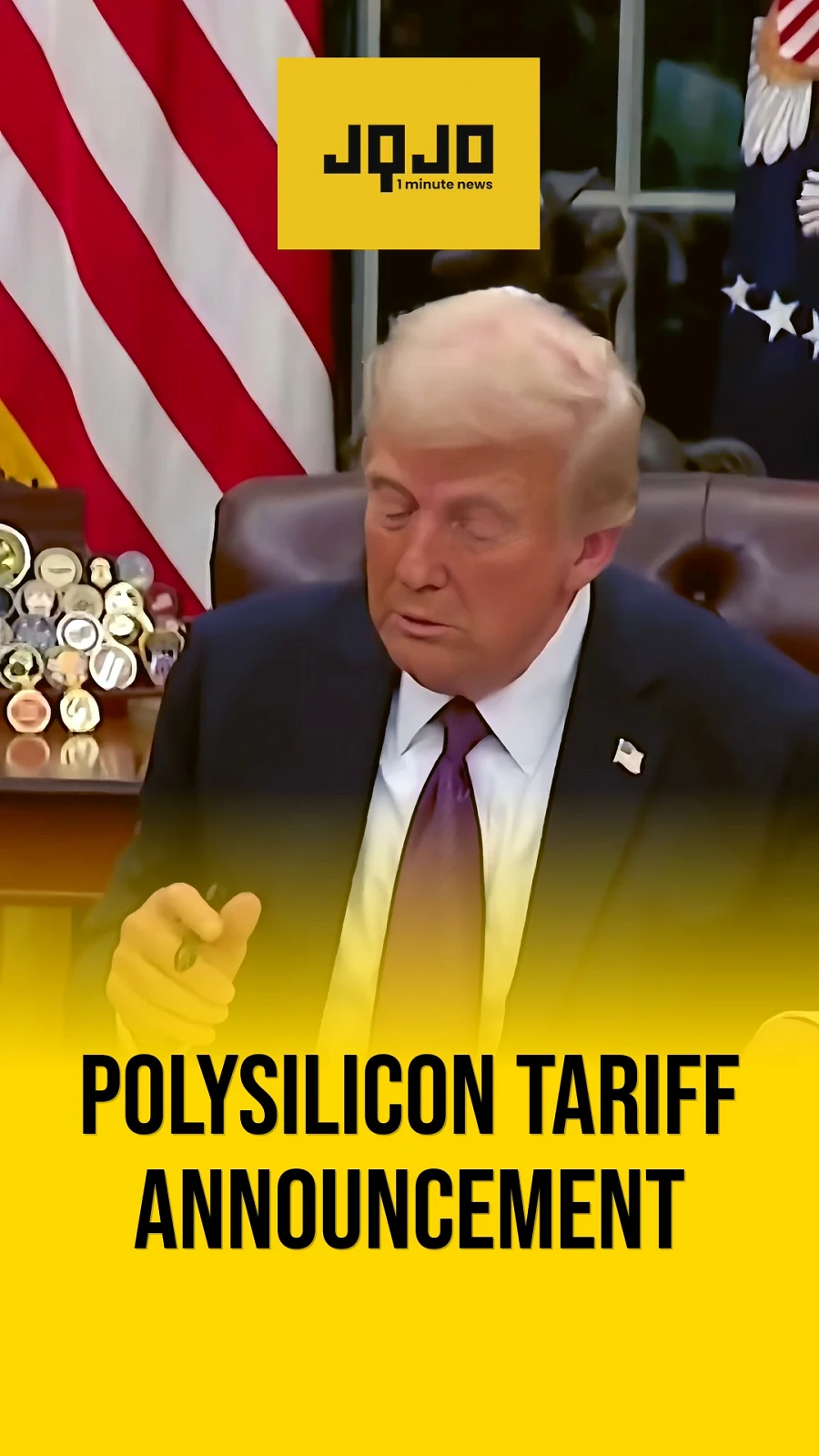
Trump Imposes 15% Tariff and Price Floors on Polysilicon to Counter China
Tap title to read story
President Donald Trump signed a proclamation implementing a 15% tariff and a series of minimum import prices on polysilicon and its derivative products. The executive action utilizes Section 232 of the Trade Expansion Act of 1962, citing national security and economic protection for domestic semiconductor and solar supply chains. Polysilicon serves as an ultra-pure foundational material at the start of manufacturing supply chains for both advanced artificial intelligence computer chips and solar panels. China currently dominates global production of the material, raising strategic concerns within the administration regarding foreign dependency and domestic manufacturing viability. Under the presidential order, the administration established specific price floors across multiple stages of production. Minimum import prices are set at $21 per kilogram for unprocessed polysilicon, $100 per kilogram for polysilicon ingots and wafers, $0.22 per watt for solar cells, and $0.38 per watt for finished solar modules or panels. Additionally, a 15% ad valorem tariff is levied directly on downstream derivative products to incentivize domestic onshoring and protect American manufacturing bases. Commerce Secretary Howard Lutnick stated that securing the domestic supply chain for foundational inputs is necessary to support the rapid expansion of silicon wafers required for advanced U.S. technologies. The remedies outlined in the proclamation are scheduled to take effect 120 days after signing, going live at 12:01 a.m. on December 4. The 120-day delay aims to provide companies and industrial buyers time to adjust commercial contracts and supply arrangements. Furthermore, the proclamation authorizes the Department of Commerce to establish a targeted incentive program. This initiative will
More context
Timeline
- On 2005, United States held fifty percent global polysilicon capacity.
- On July 2025, the Commerce Department launched an official investigation.
- On 2024, United States production capacity dropped below two percent.
- On August 6, 2026, President Trump signed the trade proclamation.
- On August 7, 2026, the White House published official facts.
- On August 7, 2026, Commerce Secretary Howard Lutnick announced details.
- On December 4, 2026, the trade measures take full effect.
- On late 2026, companies will rush imports before the deadline.
- On 2027, domestic manufacturers anticipate increased federal facility investment support.
- On 2028, domestic supply chains might expand advanced chip manufacturing.
Why it matters
Tariffs and price floors will disrupt existing polysilicon import contracts. Domestic solar and semiconductor manufacturing capacity should expand significantly over time. Solar developers, chip makers, and Chinese material exporters face disruption. Prioritize official White House proclamations and corporate trade association statements.
Coverage notes
Left outlets emphasize potential consumer cost hikes and trade tensions. Center reports focus on policy mechanics and domestic supply chains. Right coverage highlights manufacturing protectionism against unfair Chinese economic dumping.
Primary report
On August 7, 2026, the White House issued executive proclamation.
Sources
JQJO Editorial Desk · Human reviewed · AI assisted. Report a correction.