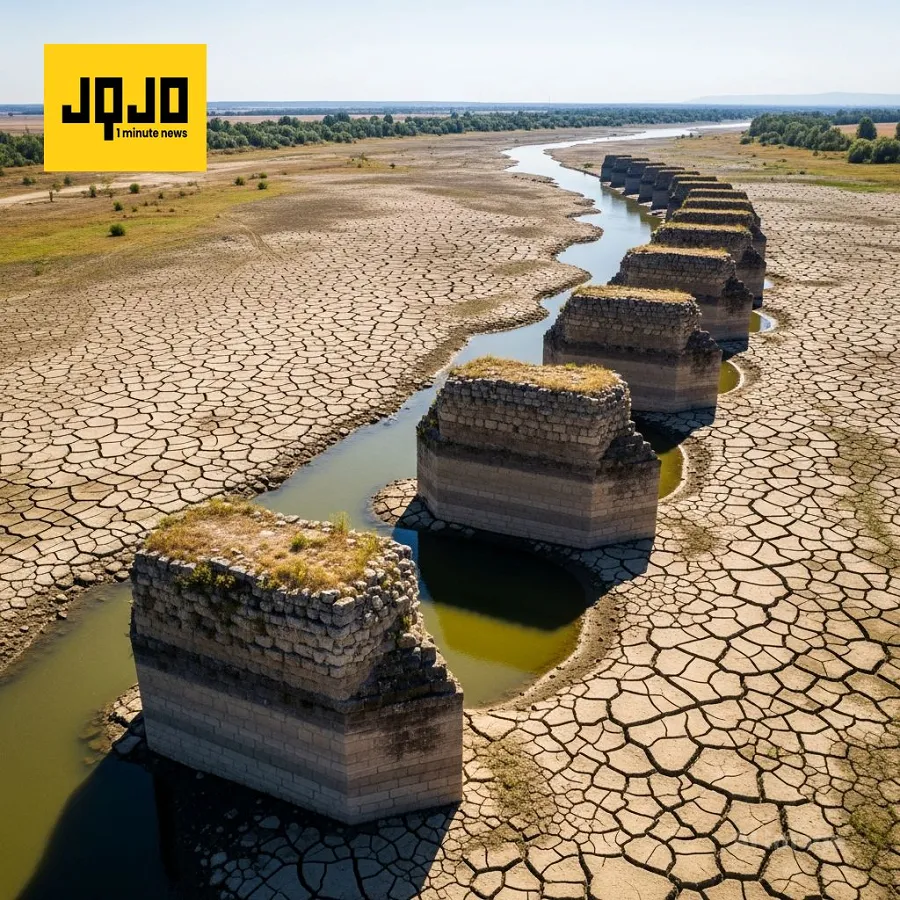
Low Danube water levels in Bulgaria expose Roman-era bridge
Tap title to read story
SOFIA, Aug 6 (Reuters) - Exceptionally low water levels on the Danube have exposed parts of the foundations of the ancient Constantine Bridge, giving Bulgarian archaeologists a rare opportunity to document what they describe as one of the Roman Empire's most impressive engineering achievements. A succession of record-breaking heatwaves in Europe this summer has caused a severe drought in parts of the continent, affecting major waterways such as the Danube and the Rhine."For archaeologists, these moments are extremely valuable because nature briefly reveals an object that is hidden beneath the Danube for most of the time," said Pavel Popov of the Regional Historical Museum in Pleven. "It gives us a rare opportunity to observe, document and study it in its real environment." The bridge, commissioned by Emperor Constantine I and inaugurated in A.D. 328, linked the ancient city of Ulpia Oescus with Sucidava in what is now Romania. Stretching more than 2 km (1.2 miles), it is regarded as one of the longest bridges of antiquity, though short-lived. It is believed to have been largely destroyed around A.D. 367.Last Tuesday, a team from the Pleven museum carried out aerial photography and documentation of visible bridge remains, close to the village of Gigen in northern Bulgaria. Researchers used drones to map and photograph the exposed remains, tracing the line of visible foundations and assessing their condition.Reporting by Stoyan Nenov; Writing by Ivana Sekularac, editing by Andrei Khalip
More context
Timeline
- On July 5, 328: Emperor Constantine I inaugurated the bridge.
- On July 20, 2026: Danube water levels fell to lows.
- On August 5, 2026: Severe European heatwaves worsened extreme droughts.
- On August 6, 2026: Low waters exposed Roman bridge foundations.
- On August 6, 2026: Researchers deployed drones mapping ancient structures.
- On August 15, 2026: Archaeologists will finish comprehensive drone analysis.
- On September 1, 2026: Receding river waters may reveal artifacts.
- On October 1, 2026: Seasonal rains will gradually raise levels.
- On July 1, 2027: Climate policies will address European droughts.
- On January 1, 2030: Enhanced preservation frameworks will protect sites.
Why it matters
Minimal direct impact on American domestic shipping or trade infrastructure. Heightened awareness of global climate impacts on cultural heritage sites. Bulgarian researchers, regional historians, and European agricultural shipping transport industries. Verify official archaeological reports distinguishing historical discoveries from climate crises.
Coverage notes
Left: Emphasizes climate change impacts and severe global environmental degradation consequences. Center: Focuses strictly on factual archaeological discoveries and drought water statistics. Right: Highlights historical engineering heritage without emphasizing broader climate policy narratives
Primary report
Reuters published original reporting on August 6, 2026, announcing discoveries. Direct URL:
Sources
JQJO Editorial Desk · Human reviewed · AI assisted. Report a correction.