The main Kremlin party keeps control of Russian parliament after a carefully orchestrated vote
Tap title to read story
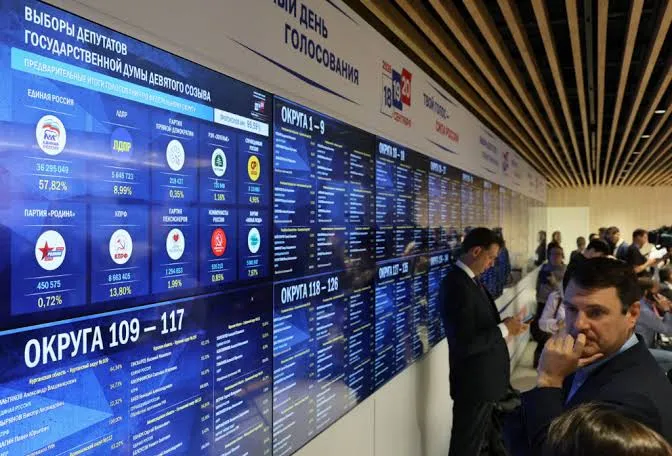
Russia's ruling United Russia party has secured a commanding supermajority in the State Duma following a three-day national election characterized by strict government control and the exclusion of genuine opposition. Preliminary results reported by the Central Election Commission on Monday showed United Russia capturing 355 of the 450 parliamentary seats, securing nearly 58 percent of the party-list vote and leading in 208 single-mandate races. The contest marked Moscow's first parliamentary election since the 2022 full-scale invasion of Ukraine, controversially incorporating polling stations in Crimea and four occupied Ukrainian regions. Election officials reported a turnout of over 59 percent, the highest in a decade. Independent watchdogs and international critics denounced the vote as a managed exercise lacking democratic legitimacy, citing the Supreme Court's disqualification of the anti-war Yabloko party and heavy state media saturation. Meanwhile, the final day of voting coincided with intensive long-range Ukrainian drone strikes targeting the Moscow region.
More context
Timeline
- On September 19, 2021, United Russia previously won 324 seats in legislative elections.
- On February 24, 2022, Russia launched its full-scale military invasion of Ukraine.
- On August 18, 2026, Russia's Supreme Court barred the opposition Yabloko party.
- On September 18, 2026, three-day parliamentary voting commenced across Russian regions.
- On September 18, 2026, turnout reached approximately 30 percent by Friday evening.
- On September 20, 2026, electronic voting systems experienced reported cyberattacks and technical disruptions.
- On September 20, 2026, massive Ukrainian drone strikes targeted Moscow and surrounding infrastructure.
- On September 21, 2026, election officials announced United Russia secured 355 seats.
- On September 21, 2026, European Union officials denounced the elections as a sham.
- On September 21, 2026, Russian defense officials vowed intensified retaliation against Kyiv.
Why it matters
Immediate US impact: Immediate US impact involves heightened diplomatic tensions and sanctions oversight. Possible long-term US impact: Long-term US impact includes protracted geopolitical friction over occupied territories. Most affected groups: Most affected groups include Russian citizens, dissidents, and Ukrainian border populations. Reader priority: Readers should prioritise wire services and verified international monitoring reports.
Coverage notes
Left: Framing emphasizes autocracy, suppression of opposition, and illegitimate annexation. Center: Framing focuses on official results, electoral statistics, and wartime context. Right: Framing highlights national consolidation, voter turnout, and western double standards.
Primary report
Central Election Commission announced preliminary results on September 21, 2026.
Sources
- Radio Free Europe / Radio Liberty
- The Guardian
- New Voice of Ukraine
- New York Times
- Washington Post
- Moscow Times
- San Francisco Chronicle
- Associated Press
- Reuters
- Hindustan Times
- The Hindu
- PBS NewsHour
- Around Prague
- Wall Street Journal
- Politico
- Financial Times
- Bloomberg
- Euronews
- Sky News
- CBC News
- CTV News
- NPR
- Chicago Tribune
- Houston Chronicle
- The Hill
- Axios
- Al Arabiya
- The New Voice
- The Straits Times
- Sputnik News
- The Times
- The Australian
JQJO Editorial Desk · Human reviewed · AI assisted. Report a correction.