US military moving drones to South America ahead of anticipated counternarcotics operations
Tap title to read story
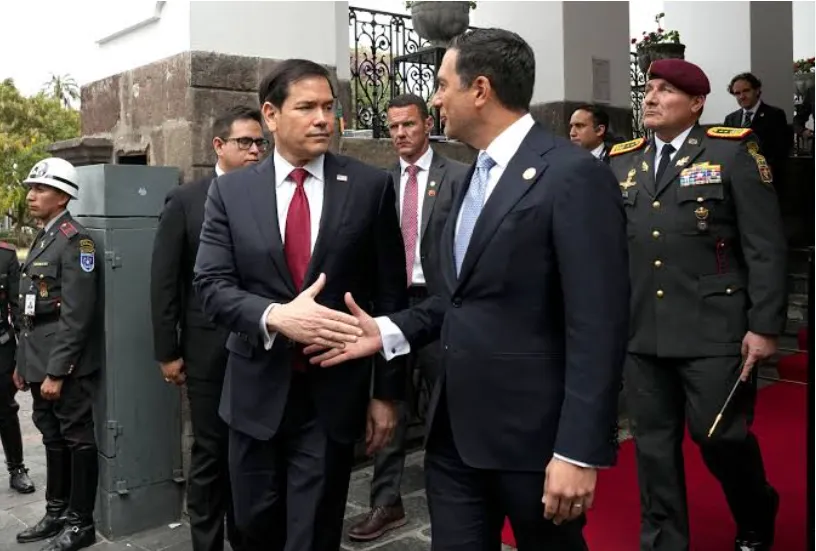
The United States Southern Command delivered four long-range K1000 unmanned aerial system drones, valued at over six million dollars, to Panama's Ministry of Public Security. U.S. Ambassador to Panama Kevin Marino Cabrera formally transferred the equipment during a ceremony designed to enhance regional surveillance and combat transnational drug trafficking and human smuggling. Funded by the United States government, the initiative aims to monitor remote borders and intercept illicit networks before they reach American soil. Coinciding with the delivery, ten Panamanian drone pilots graduated from a six-week training program administered by American manufacturer Kraus Hamdani Aerospace. The deployment supports broader strategic efforts by the United States to secure regional transit corridors and disrupt cartel operations at their source through advanced autonomous aviation technology.
More context
Timeline
- On January 28, 2025, the United States Navy announced early regional hybrid fleet initiatives.
- On November 13, 2025, Defense Secretary Pete Hegseth formally named Operation Southern Spear.
- On October 25, 2025, USSOUTHCOM established a joint task force targeting regional drug cartels.
- On April 7, 2026, U.S. Air Forces Central awarded a major contract for K1000 drones.
- On September 11, 2026, Central American security forces expanded unmanned aerial surveillance integration.
- On September 15, 2026, defense reporting highlighted advanced ultra-long-endurance drone capabilities for tactical deployments.
- On September 16, 2026, Ambassador Kevin Marino Cabrera delivered four K1000 drones to Panama.
- On September 16, 2026, ten newly-certified Panamanian drone pilots completed specialized U.S. training.
- On September 17, 2026, international wire services and official media documented the equipment transfer.
- In coming months, security forces will deploy the unmanned systems for continuous border surveillance.
Why it matters
Immediate US impact: Enhanced aerial surveillance strengthens regional border defense and drug interception. Possible long-term US impact: Long-term deterrence against transnational smuggling syndicates protects American borders. Most affected groups: Panamanian security forces and regional defense agencies coordinate anti-drug operations. Reader Priorities: Readers should prioritize official defense announcements and verified regional security updates.
Coverage notes
Left: Highlights potential overreach and militarization in regional foreign policy. Center: Emphasizes bilateral security cooperation and technological counter-drug capabilities. Right: Focuses on aggressive border protection and dismantling transnational drug cartels.
Primary report
U.S. Southern Command delivered six million dollars in drones to Panama.
Sources
- The Guardian
- U.S. Southern Command
- Diálogo Americas
- Airforce Technology
- Kraus Hamdani Aerospace
- Wikipedia
- Defense News
- Reuters
- AP News
- Military.com
- Stars and Stripes
- Breaking Defense
- Jane's Defence Weekly
- Bloomberg
- CNN
- BBC News
- Financial Times
- U.S. Department of State
- U.S. Department of Defense
- DVIDS
- U.S. Immigration and Customs Enforcement
- U.S. Customs and Border Protection
- Drug Enforcement Administration
- U.S. Department of Justice
- Miami Herald
- Americas Quarterly
- Center for Strategic and International Studies
- Atlantic Council
- Wilson Center
JQJO Editorial Desk · Human reviewed · AI assisted. Report a correction.