30-Year Treasury Yield Hits 20-Year High as War Fears Mount
PUBLISHED Aug 18, 2026, 2:01 PM ET
Read, Watch or Listen
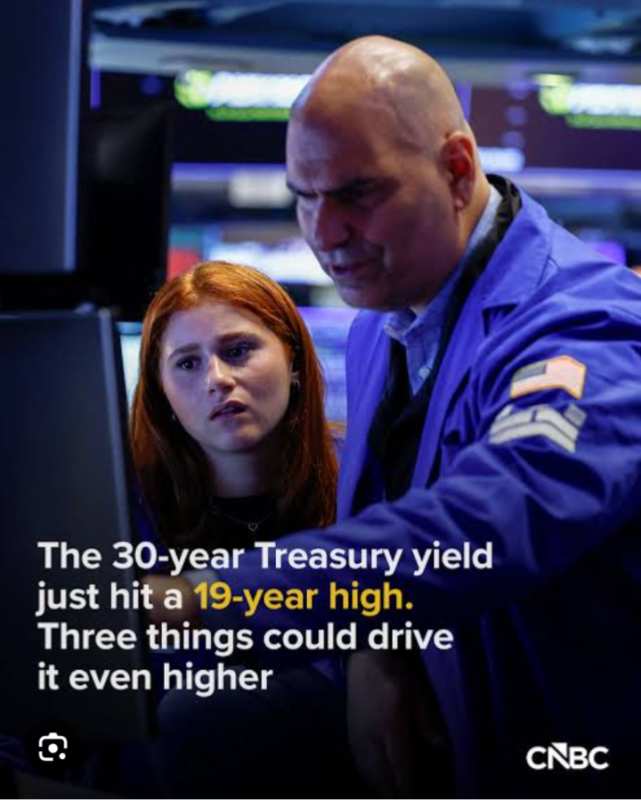
U.S. Treasury yields surged Tuesday, with the 30-year yield reaching 5.321%, its highest level since June 2007, as investors weighed inflation, government borrowing and escalating Middle East tensions. The 10-year yield rose to 4.7259%, according to Reuters market data. Brent crude traded around $91 a barrel after U.S.-Iran ceasefire negotiations stalled, raising concern that prolonged conflict could keep energy prices elevated and complicate the Federal Reserve’s inflation fight. Global bond markets weakened, while U.S. stocks faced pressure from higher discount rates overall today. The supplied report’s Monday equity figures are accurate but were dated incorrectly: the S&P 500 closed Monday at 7,745.06, the Dow at 53,459.78 and the Nasdaq at 26,644.91, according to AP. A $25 billion 30-year Treasury auction last week produced a 5.216% yield, the highest auction yield since 2001. Analysts warn that persistent inflation, fiscal deficits and heavy debt issuance could sustain pressure on long-term borrowing costs.
By Emily Rhodes | JQJO News
Timeline of Events
- On 2001, Treasury’s 30-year auction yield reached historically comparable levels.
- On June 12, 2007, 30-year Treasury yields reached similar highs.
- On July 9, 2026, Treasury’s 30-year auction yield reached 5.058%.
- On August 13, 2026, Treasury sold $25 billion in bonds.
- On August 17, 2026, U.S. stocks closed lower amid inflation.
- On August 17, 2026, the ceasefire expired without broader agreement.
- On August 18, 2026, 30-year Treasury yields reached 5.321% intraday.
- On August 18, 2026, Brent crude traded around $91 barrel.
- On August 19, 2026, markets examine newly released FOMC minutes.
- Over coming weeks, sustained oil prices could prolong inflationary pressures.
- Over coming months, higher yields could raise refinancing costs nationwide.
- Over coming years, fiscal deficits could keep long-term yields elevated.
News Intelligence
- Immediate US impact: U.S. borrowing costs rise, pressuring stocks, mortgages, businesses, government finances.
- Possible long-term US impact: Persistently higher yields could constrain growth and increase interest expenses.
- Reader priority: Readers should prioritize primary data, timestamps, market context, independent confirmations.
- Most Affected: Investors, borrowers, technology companies, homeowners, policymakers face the greatest exposure.
- Articles Published:
- 14
- Right Leaning:
- 0
- Left Leaning:
- 1
- Neutral:
- 13
- Distribution:
- Left 7%, Center 93%, Right 0%
Left: Left coverage emphasizes consumer costs, deficits, inequality, and policy consequences. Center: Center coverage emphasizes yields, oil prices, deficits, and market mechanics. Right: Right coverage emphasizes fiscal discipline, borrowing, inflation, and Fed credibility.
On August 18, Reuters reported 5.321% yield amid bond-market turmoil. https://www.reuters.com/world/china/global-markets-view-europe-2026-08-18/
Coverage of Story:
From Left
Cooling UK labour market 'questions need' for Bank of England rate hikes; grocery inflation slows to two-year low - as it happened
The GuardianFrom Center
30-Year Treasury Yield Hits 20-Year High as War Fears Mount
CNBC MarketWatch MarketWatch Barron's Business Insider Reuters Wall Street Journal Investmentnews Barclays Investors Repubblica Investors InvestorsFrom Right
No right-leaning sources found for this story.






Comments